Kelly Taylor Mitchell charts an intuitive multidisciplinary practice: gathering ancestors, objects, and memories into a metaphorical swamp that surfaces through paper and fabric textiles, performances, and installations. Based between Atlanta, Georgia, and San Juan, Puerto Rico, Mitchell’s practice unfolds as a diasporic mapping project of self-liberated people across the Americas. Sites like the Great Dismal Swamp—a deeply intervened site connected to her familial lineage and historically a site of enclosure for maroons in southeastern Virginia and northeastern North Carolina—are sutured with other marronage geographies like Bahia, Brazil, through handmade paper scenes.
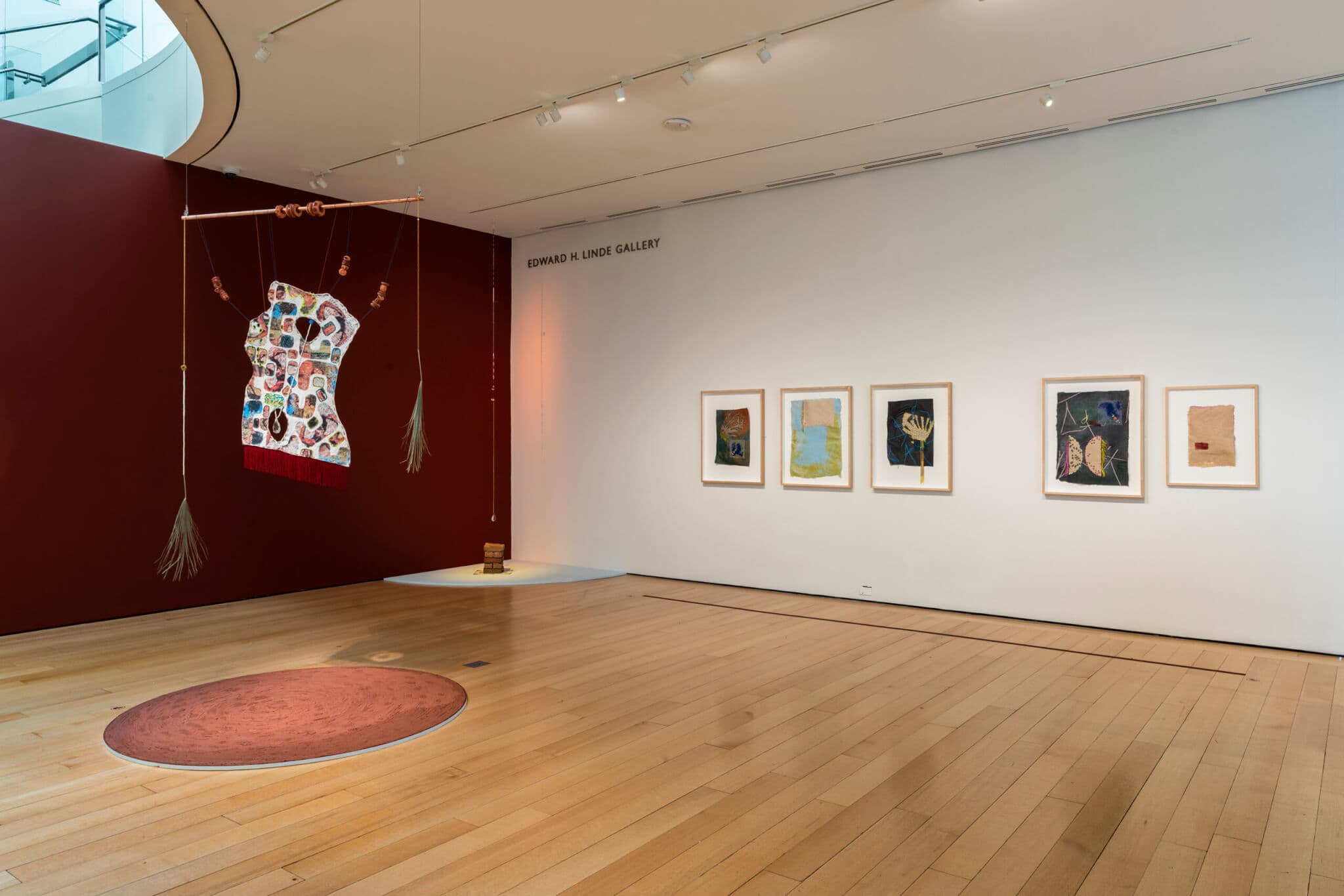
As an SMFA alum (BFA ’15), Mitchell was awarded the 2022 Tufts Traveling Fellowship, which supported her sojourn to Brazil’s yearly Iemanjá (Yemayá) festival. Mitchell was enthralled by the gathering, the ritual, and the aliveness of the festival, and ignited by a continuation of her diasporic mapping project. The resulting pieces are on view through April 26 at the Museum of Fine Arts, Boston, in an exhibition titled “mouth wide open.” The exhibition transports viewers through textural interventions to Brazil, anchoring the works in their temporary home in Boston through stacked bricks and orbs of brick dust.
One contour of her topographic installation reveals itself through paper works merging found materials, emblems of protection, beads, her familial archive, and deep devotion. Through sheets emblazoned with bouts of color and adornments, we travel with Mitchell across her works and worlds as she connects the tangible to the intangible.
The following conversation has been edited and condensed.
Jordan Barrant: I’ve been reading The Salt Eaters, a text about a healing ritual, and thinking about the title of your exhibition, “mouth wide open,” which references this sense of awe and wonder when you got to Brazil. In the text, there’s a quote that says: “Eyes wide open to the swing from expand to contract, dissolve congeal, release restrict, foot tapping, throat throbbing in song to the ebb and flow of renewal, she would welcome them healed into her arms.” Can you take me with you to Brazil, to the Yemayá festival, and that sense of awe and wonder that welcomed you?
Kelly Taylor Mitchell: I’m there with my wife and my uncle, who I see as a steward of family knowledge, lore, myth, and another sort of memory worker. We’re there days before the festival begins. It was a gift to see the transformation of the neighborhood and witness so much that felt sacred before a sacred event took place. That really felt present in food stalls [like] the smell of the acarajé in the air and the oil for frying. Scent is a component I’ve used in my work and is a trigger for memory. This dish feels like a perfect analogy for me thinking about my work. It’s bringing together what I really identify as diasporic ingredients in my experience and learning of diaspora. You have the peanuts; you have the black eyed peas, the okra, all in one dish.
JB: If we’re looking at this diasporic map and we start in Brazil, take me to where that practice of ancestor worship started.
KTM: The diasporic mapping project started in the Great Dismal Swamp as a result of the archive I received from my grandpa, Papa Mitch. When he passed away, I received these notes, film slides, newspaper clippings about our family history and story. Through that I learned about this ancestral legacy of marronage, specifically in the Great Dismal Swamp, which I did not know about previously despite returning to North Carolina often. Through learning about the history of the swamp, I began slowly engaging with the history of marronage because this isn’t a practice that is really active in the national memory in the United States in the way it is in a place like Brazil, which is part of what brought me there.
Through this work, learning and making textiles, which I was calling spiritual technologies, I came to realize that in trying to learn about the history of this place, especially as it relates to spiritual retentions, I am developing my own spiritual practice. I say my own with the distinct understanding that it’s not my own at all; it’s deeply informed by all of these other traditions that I’m gleaning, learning, and borrowing from.
JB: Alongside the lineage of marronage, what was it about the orisha Yemayá that made you want to go to Brazil and experience a full festival celebrating her?
KTM: Yemayá is not only the mother of all orishas, of all living things, but of the sea, of water, of birth, of life or life-giving. In this process of diasporic mapping, I have really understood my practice as a practice of ancestor worship. Much of [it] is engaging [with] passed down practices that were shared with me indirectly, to attempt to excavate and to connect with these spiritual traditions and retentions as it relates to these African religious traditions that are historically, or at least in the context that I’m exploring, Yoruba-derived. That sort of reference point comes from the relationship to the Great Dismal Swamp and religious traditions that are historically and actively today born out of marronage. And so all of that [is] to say I’m not an initiate in these traditions, but I’m learning with them and from them and developing my own practice through my art.
Learning about Candomblé and Afro-syncretic tradition, I began to learn more about Yemayá. My work is dependent on water and does not exist without water. I’m also really conscious that oftentimes the paper-making process can be very wasteful as it relates to water, so I’m interested in more conscious ways to utilize that resource in the process. Part of the desire to connect with this specific festival was the gratitude and sense of the sacred I have with the resource in and of itself and this practice I’m developing that is so deeply informed, guided, and illuminated by Afro-syncretic traditions.
JB: In Come Bearing Gifts (2025) you depict an offering procession that took place in Brazil. What did your paper-making procession look like for this body of work?
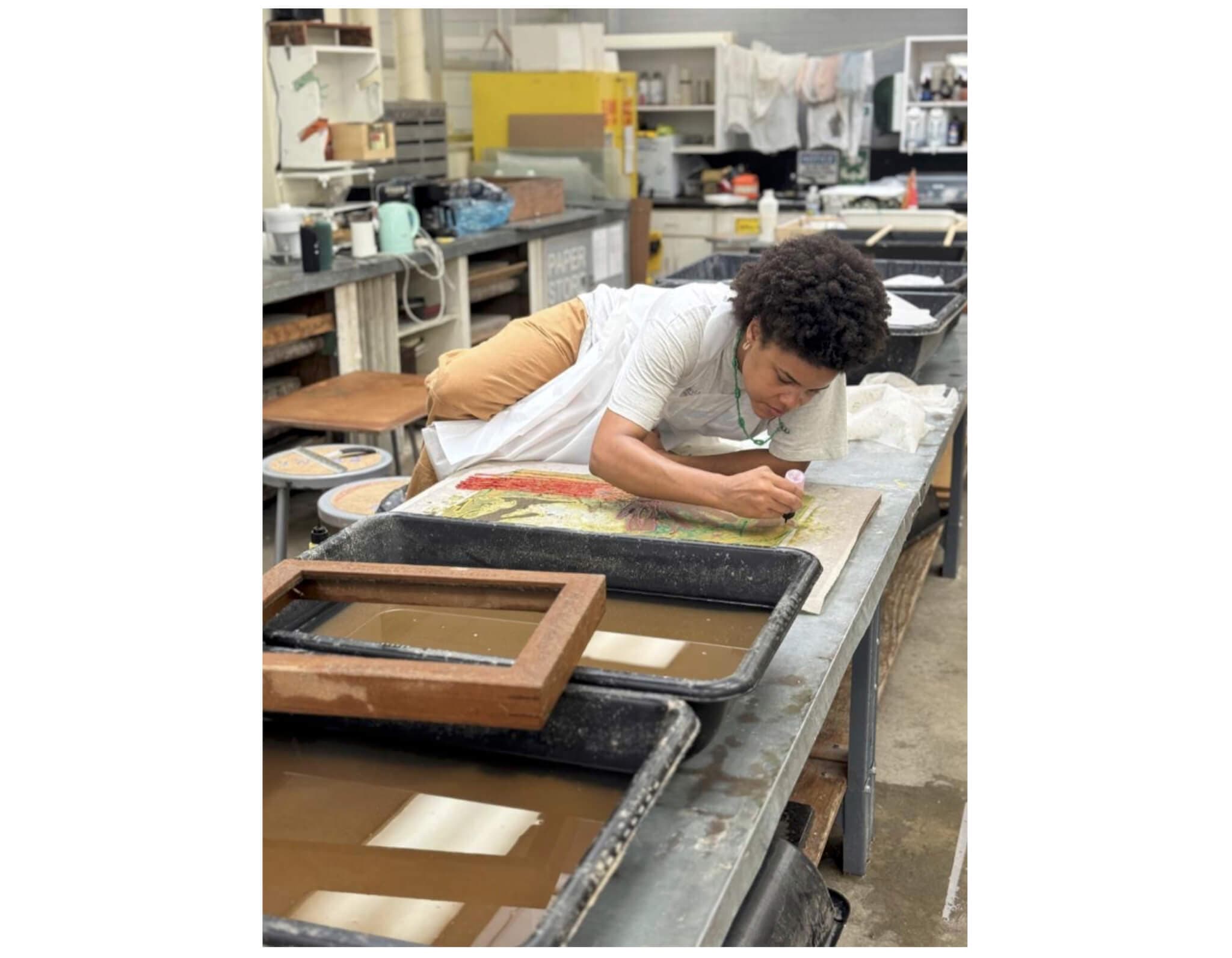
KTM: I work really improvisationally and intuitively, and I see myself as a collector; I’m always collecting beads, tassels, family reunion T-shirts, napkins, textiles, and materials that speak to me and have not just a sensorial quality but that feel like they’re an indicator of living. Gathering the materials, collecting the textiles, finding these bits and bobs by gathering, finding potential collaborators to pull in, that’s all the procession.
So I’m gathering all those things and bringing them to the studio, and also utilizing Alabama Spanish moss that I had gotten from my Uncle John’s house, and then all of these other accoutrements and adornments and pieces of ornamentation that I sort of spread out.
I knew I wanted to think about the stitch mark and what it means when we take that stitch out of its most understood function as something that physically ties multiple or two pieces of disparate elements together. I would argue that’s still happening. We’re not piercing the paper with thread, but it still becomes this mark that we follow, and I’m really interested in thinking about it as a language that can communicate just as a phonetic language would and does.
JB: Now I have this image in my mind of a map with these sutures and stitches in it. How does stitching come into your works of other mediums—and how does it relate to other materials in the installation, like the bricks or brick dust?
KTM: I see the stitching as folding in—especially in thinking about things like the bricks or even the beading—as being part of this language of spiritual protection. I started using the stitching in my textile works for obvious reasons—to hem and create the forms—and again for spiritual functionality, or spiritual technology, that is used to protect or cover the images of private ritual performance that are image-transferred onto the surface of these textile works. So the stitch isn’t utilized to connect the image to that base textile; that’s happening with the image transfer process. It would stay without stitching, and the stitches come to protect those images that are private. I’m really interested in thinking about the opacity of the work. I want to share this process that I’m navigating, but I also want to protect it.
Stitching is a tool to do that. The brick dust is a tool to do that. The brick dust is not really at play in this work, because in an institution like [the MFA]—an encyclopedic museum—the typical material that I would use at the base of a textile, loose brick dust, wouldn’t function in that space because of institutional constraints. So we made this composite material so it won’t fly away or be disturbed. But I’m really interested in those disturbances because even the brick dust, whether for the paper pieces or the textile or even instead of stanchions, creates this protective boundary.
When it’s loose brick dust and someone violates that boundary, you have evidence of that. You see their footprint. What’s also interesting to me is the possibility that that violation isn’t a violation at all. There was some sort of access that was granted when we think about this tradition used in the American South of laying brick dust as a way to keep out those who mean you harm. If someone could cross that boundary, then harm wasn’t intended. I see the stitch as a part of that practice.
JB: How do you approach thinking of the paper long-term and honoring its aliveness?
KTM: A willingness to mend just like ourselves as living beings. Always being prepared to heal and find new areas that you felt like you’d healed and then, look—a new scrape, a new tear, that needs your attention. That’s how I see it: just staying attentive and expecting it to require that observation and caretaking, because the works absolutely tear. I have a flat file full of paper scraps and I just tear [from] them, adhere that scrap to the back, and keep it moving.