Tuesday night a former member of Biden’s national security council posted an Instagram story stating, “How much of my soul did I sacrifice to go on with my day while an entire civilization was being threatened on my behalf?”
On the heels of our small (but mighty) team working into Tuesday night hustling hard to bring you Matthew Lawrence’s news story out of Providence, RI about a shadowy organization paying local artists to put up murals across the US that reads like some kind of reverse-Pizzagate weaponization of public art, his words hit me. After having threatened a genocide in Iran and—given the likely knock-on effects—the entire global community with nuclear destruction, the president backed off just twenty minutes before the 8 p.m. EST ultimatum. The day got dubbed TACO (Trump Always Chickens Out) Tuesday after what started as a humorous acronym coined by FT columnist Robert Armstrong ribbing the way that Trump’s blustery tariffs threats whipsaw markets. Though it has retained an inflection of the original humor, the term has evolved into a serious policy-analysis shorthand to describe how Trump’s similarly volatile national security and international relations policy decisions whipsaw public leaders—foreign, national, corporate, and even members of Trump’s own team. As the mid-week compressed version of the Cuban Missile Crisis unfolded, viral AI Lego rap videos dominated the theater of public sentiment, evolving the war from kinetic to hybrid tactics. With Beirut bombarded by more than a hundred missiles in ten minutes during the cease fire and as cities as far away as Buenos Aires cutting public transit in response to spiking fuel prices, again international instability is creating local crises as it exposes vulnerabilities and dependencies in global interdependent systems.
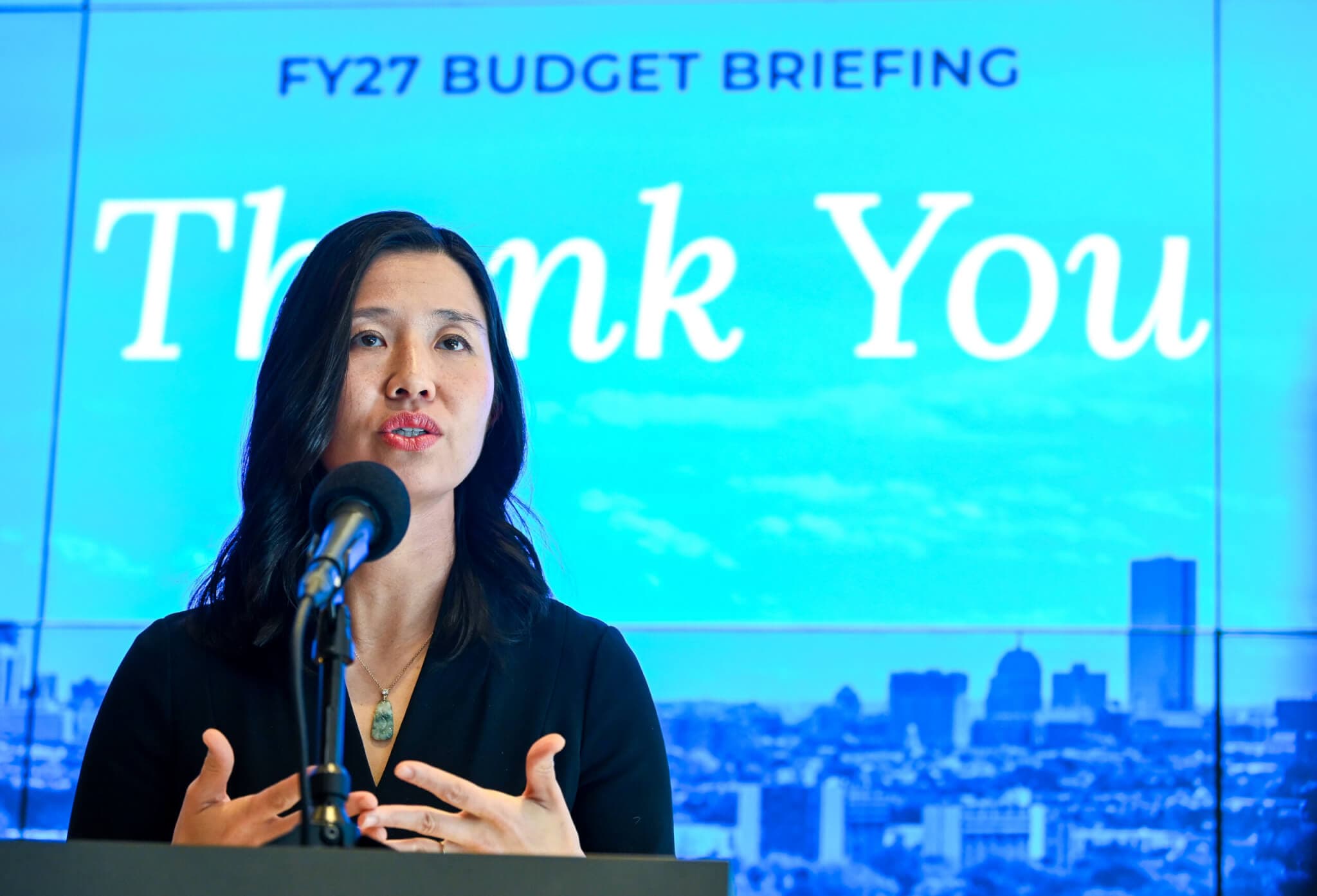
In this context, Boston’s Mayor Wu has been on a PR circuit stumping to defend what it’s clear her team knows are going to be controversial cuts in her newly unveiled proposed city budget. Boston, and the commonwealth, are in financially choppy waters. Major blows to the city coffers include companies and residents leaving for more affordable options, federal agencies diverting funds to red states and delivering cuts to academia, and rising staffing costs like healthcare. Among the cuts are some pretty heavy chops to the Mayor’s Office of Art and Culture (MOAC)—which represented less than 1% of the budget—as well as cuts to grant programs that help fund cultural businesses. The city is confronting tough times and tougher choices for sure, but given the amount of money we are talking about, cuts to a department that represented such a minor percentage of the budget signals more of an agenda priority than actual savings. For context, the cuts to the MOAC budget would save the city $1.2M, while negotiating with city labor unions to no longer cover GLP-1 medications alone is estimated to save $11M.
This seems as logical as any transition to Josh Kline. The artist’s viral article in October (of all viral-improbable outlets) takes the position that the cost of real estate in New York is driving the decline in opportunities for artists that is making the whole cultural system such an unforgiving grind and so mid. Boston, for what it’s worth, got an inglorious shout-out in the piece, highlighting that the city’s ambitious artists (as well as Cleaveland’s, Baltimore’s, and Lawrence, Kansas’s) seeking career advancement are obliged by the international art system to decamp to either LA or New York, cities where the cost of existence is largely unachievable for mortals whose rent is paid with labor rather than capital. The piece has resparked debate about the current state of the American art industry and has inspired responses by Aruna D’Souza for Hyperallergic and Jenny Wu for ArtReview out of the UK. Oddly missing from the conversation surrounding the piece are its antecedents. Chris Wiley identified this issue in 2018 for artnet, he even gave it a snappy name, debt-aesthetics.
So here’s our conundrum as citizens. At home, the collective downward mobility is causing societal shifts that J.P. Morgan’s CEO Jamie Dimon identifies as a potential market risk (along with societal changes from AI) in his annual shareholder letter. Abroad, we face the quandary of representing a political system that political scientist Stephen Walt has described as “predatory” in the way it wields its hegemony, and that is using us as justification to do so. As international coalitions of artists implore the Venice Biennale to ban the US (along with Russia and Israel) from participating in the “Olympics of Art” for war crimes, it’s hard to think of a rebuttal.